One system from the wrist to the rack
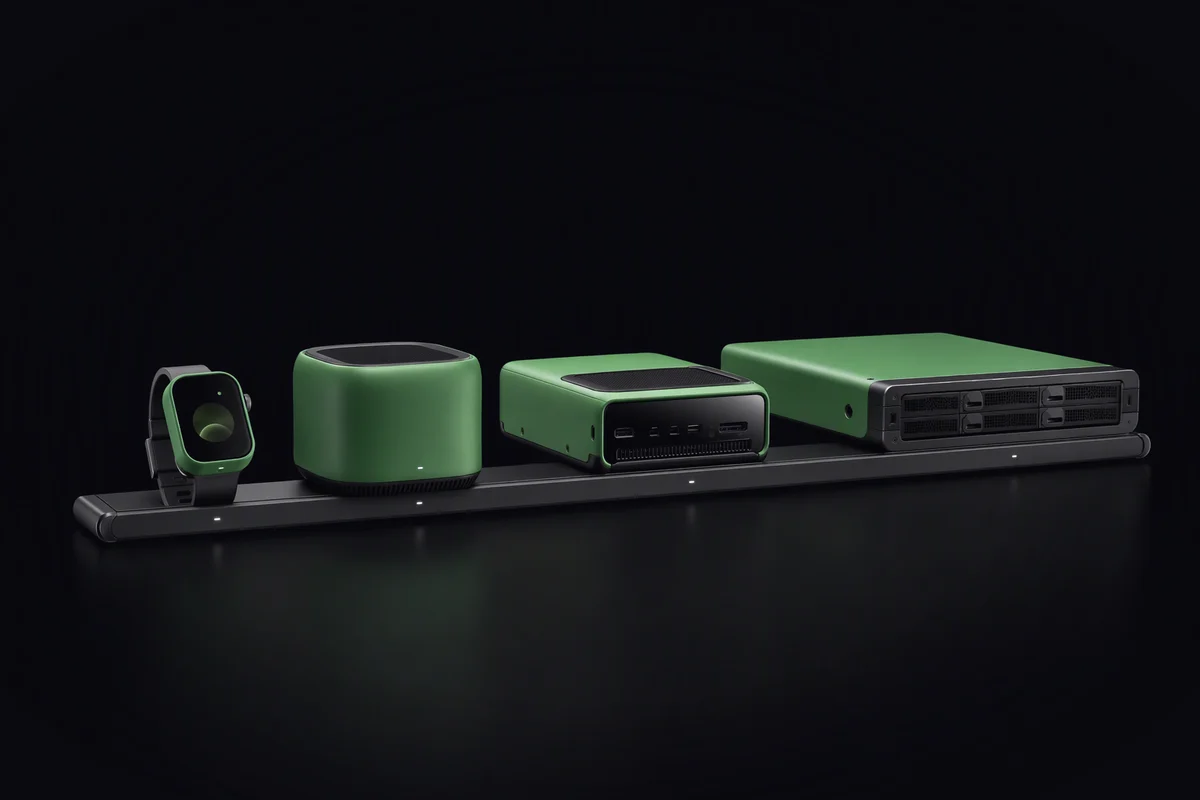
Picture an ordinary week with an assistant that is actually yours. A band on your wrist takes a note in the car park. A node on the shelf at home files it into the long memory overnight. A small robot in the hallway is asked to bring the parcel in from the porch. A transcription job too big for any of them runs on a cloud node somewhere. Four machines, one assistant, one person.
Now look underneath. The band runs a vendor’s embedded system with its own update tool. The node runs a general-purpose server distribution someone hardened by hand. The robot runs whatever its controller board shipped with. The cloud node runs a provider’s image you have never seen. A security fix arrives on Tuesday for one of them and on no particular day for the others. The same agent behaves slightly differently on each, and nobody can say whether that is the model or the machine.
Why it ends up this way
Nobody chooses four systems. Each device class gets its own because each was designed separately: wearables by people who care about battery, robots by people who care about motors, servers by people who care about throughput. Each picked the base that suited its own constraints, and the assistant that is supposed to span all of them is ported, patched and re-tested four times.
The result is not four times the work. It is worse, because the differences interact.
Where four systems go wrong
Four update stories. One device updates packages, one flashes firmware, one replaces containers, and one is never updated at all because nobody remembers how. Each needs its own rollback plan, and usually one of them has none.
Four security postures. Verified boot on one, a writable root on another, a debugging shell left open on the robot because it was needed once. The weakest device sets the level for the whole set, because they all hold pieces of the same life.
Behaviour that depends on where it runs. Different kernels, different libraries, different schedulers. An agent that works on the node and stalls on the robot is a bug report nobody can reproduce.
Four audits. When someone asks what runs on your devices, the honest answer is four package lists in four formats, maintained by four different upstreams.
Identity rebuilt each time. Keys, permissions and the record of who asked for what get re-implemented per platform, and the seams between them are where things leak.
One base, several profiles
The alternative is not one image for everything. A card on a lanyard and a node in a rack do not need the same components. It is one base with profiles: the same image definition, the same boot chain, the same update mechanism and the same cell runtime, with each profile adding or removing what that class of device needs.
That is how KyberLinux is designed. A profile for carried devices leaves out the desktop and keeps the power budget tight. A profile for robots adds the controllers and gives the safety envelope that KyberBot carries into a robot a system that never changes underneath it mid-shift. A profile for machines with a screen adds the keyboard-first desktop. A profile for cloud nodes adds what a server needs and nothing a person needs. Underneath, the parts that matter for trust stay the same.
What every profile shares:
- The boot chain. Every device checks what it starts against a signature, from firmware up, wherever the hardware allows it.
- The update. A whole image written to a second slot, switched at reboot, and rolled back by itself if the device does not come up healthy.
- The cells. Every agent runs in a KyberCell with the same rules, whether the cell sits on a wrist or in a rack.
- The record. One log format, so a step taken on the robot reads the same as one taken on the node.
The five forms of KyberDeck are the first hardware this is meant for, and one assistant in many bodies is the reason it matters. When the body changes, the ground should not. The same goes for the cloud: a KyberFusion node runs the same system you carry.
What it does not solve
One base is not magic, and saying so is more useful than the pitch.
The smallest devices cannot carry everything. A card has room for a thin profile; a microcontroller does not run Linux at all and pairs with a device that does. Drivers still differ per board, and some hardware will never offer a proper root of trust, in which case the system should say so rather than pretend. And one base means one mistake can reach every device at once, which is why staged rollouts and automatic rollback are not optional extras but the other half of the design.
KyberLinux is pre-launch. None of this can be installed today; it is the shape we are building towards.
A test you can run today
Make a table. One row for every device in your life that runs an assistant, an agent or any automation you rely on: phone, watch, speaker, home server, robot vacuum, and the cloud account behind them. Four columns:
- Which operating system does it run, and which version?
- How does it update, and when did it last do so?
- How would you roll it back if the last update broke it?
- Who signs the image it boots, and can you check the signature?
Count the distinct answers in each column. Every extra answer is another update story, another security posture and another audit you are carrying without having chosen to. If the third or fourth column has blanks, you have found the device that sets the security level for all the others.
- KyberLinux
- device classes
- updates
- security