Who owns the ground under your agent factory?
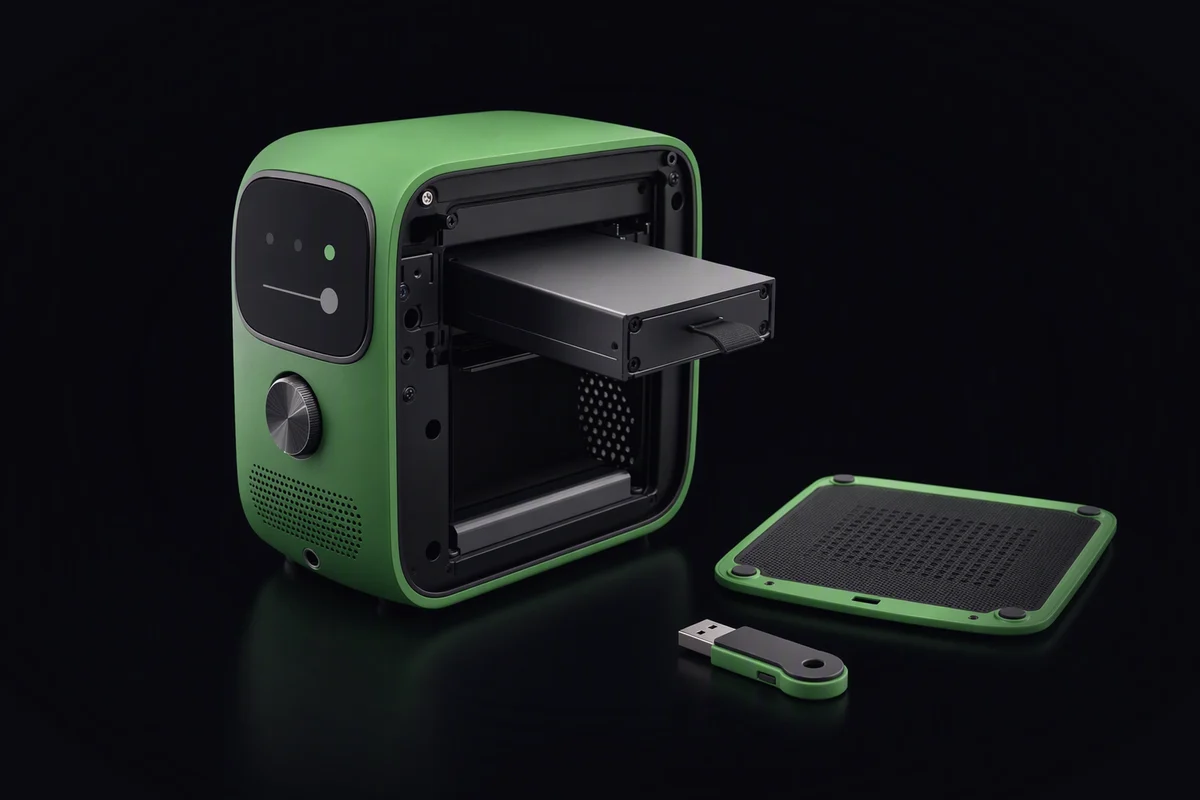
The most valuable part of an agent factory lives in the system underneath it, not in the model: in the run records, the access rules and the image the agents work on. You can switch models in a week. You cannot rebuild a year of what your agents did if that record was never yours. That is why “which model is best” matters less than “what stays with me when I change vendors”.
In the first post in this series we argued that factories will leave IT for machines with no admin. The question here is simpler and harder at once: who do those machines belong to?
Where the problem comes from
While agents run on individual laptops, it all looks harmless. Everyone installs a different tool, each with different access to mail and files, and conversations vanish when the window closes. Nobody has anything to lose, because nobody has built anything up.
A factory changes that. It pulls agent work into one loop, with one set of permissions and one record. Six months in, that record is the most accurate documentation of how your business actually works. Where it lives, in what format, and who can read it becomes the owner’s decision, not a team’s choice of tool.
What you actually own
An agent factory has several layers, and each can belong to you or to a vendor. Seen from the system, it looks like this:
| Layer | What it is | What you lose if the vendor has it | Minimum to keep yourself |
|---|---|---|---|
| Loop definition | stages, agents, rules for moving on | you cannot rebuild the loop elsewhere | a file in your repository, with history |
| Agent instructions | how an agent should work in your business | months of corrections by your team | files readable without the vendor’s tool |
| Cell declarations | what each agent may read, write and connect to | knowing who has access to your data | one list of rules you read and change yourself |
| Run records | every step, file and connection | the only evidence when something goes wrong | a record on your machine, in an open format |
| Evaluations | test tasks and their results | comparing vendors on your own work | your own set of tasks |
| Model | who does the work | freedom to move when prices change | swapping it without rewriting instructions |
| System and image | the ground the agents run on | being able to stand the factory up elsewhere | a public image definition you can build yourself |
| Hardware | where the work physically happens | control over where data goes | a choice: owned, rented or mixed |
The model sits sixth in that table. Models get cheaper and change every few months. Run records and cell declarations grow in value with every week the factory runs.
Where KyberLinux plugs in
KyberLinux covers three layers in that table: cell declarations, run records, and the system and image.
Cell declarations are files, not settings in a dashboard. Every KyberCell is created from an explicit declaration: which files, which programs, which connections. You can read it, version it next to the agents’ instructions, and take it with you.
Run records stay on your machine. The log is written in a format that an agent can read and a person can understand, with no account with us and no telemetry. If you stop using KyberLinux, the record stays with you.
The image is public and built reproducibly. The image definition is open, and reproducible builds are meant to let you check that what runs matches what was published. You can put the factory’s ground on hardware you own, not only on ours.
The model, the instructions and the evaluations are other layers. KyberLinux does not supply them, and should not. The system is pre-launch, so this is a design, not something you can install today.
Three paths and their price
A ready-made factory from a vendor. The fastest start. Agents run on the vendor’s system, in its sandbox, and the run records sit in its database. Customisation ends where the dashboard settings end, and leaving means starting from zero.
Your own factory on a general-purpose system. The team glues scripts, containers and queues together on a distribution that will run anything. The first agent works within a week. Six months later someone maintains isolation, logs and updates instead of working on the process, and every machine is slightly different.
Open ground of your own. A system that assumes agents from the start: cells, records, a known image. You choose the loop, the instructions and the models. The price is that someone, in your company or at a partner, has to understand that ground and answer for it.
Where automation hurts sovereignty
An agent that widens its own permissions. Convenient: the agent hits a missing permission and adds a rule for itself. A quarter later, nobody knows who can see what. Changing a cell declaration is always a person’s decision.
Records sent off “for analysis” by default. Some tools ship run logs to the vendor to “improve the service”. That is exactly the knowledge at stake. The agent prepares a report. A person decides what to share and with whom.
When sovereignty becomes an expensive hobby
A twenty-person company does not need its own rack of GPUs to have a sovereign factory. Hardware bought “so the data never leaves”, that nobody can maintain, ends with the agents back on laptops, only more expensive.
For most businesses it is enough that the declarations, instructions and run records stay with them, the model contract rules out training on their data, and the compute can be rented. The ground has to be yours where the knowledge accumulates. It does not have to be yours everywhere.
How to measure sovereignty
Not with a line in a security policy. You measure it by the cost of leaving.
| Vanity metric | Outcome metric |
|---|---|
| “our vendor complies with every regulation” | how many days it would take to stand the same factory up on another machine |
| “everything is in the cloud” | whether you can rebuild last quarter’s run records without a vendor account |
| number of models in the dashboard | whether you can read every agent’s access rules in one file |
| “the system is open source” | whether you can build the image the factory runs on and check it is the same one |
Where to start on Monday
Ask your team two questions. Where does the record of what your agents did last week live, and can you open it without logging in to someone else’s dashboard? If you had to move the agents to another machine tomorrow, what would have to be rewritten? If the answer is “all of it”, the factory, even a fledgling one, already belongs to someone else.
The choice is easy to name. You can build the factory quickly on someone else’s ground and accept that the knowledge of how your business works will sit with the vendor. Or you can build it a little more slowly on ground you can read, build and take with you. Both carry a price. It is worse to make neither choice on purpose.
- agent factory
- sovereignty
- open source
- KyberCell
- logs